
Profit and profitability indicators are part of the standard key-figure calculation, which can be found on the Reports tab by selecting Ratios. The following formulas are used to calculate the indicators:
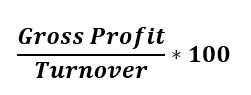
The gross profit percentage is obtained by relating the gross profit to turnover. This is an industry‑specific indicator.
Gross Profit %
Gross Profit
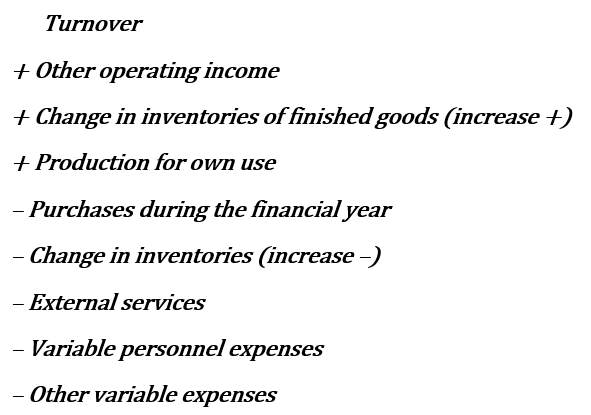
Personnel margin

The operating margin % indicates the proportion of turnover that remains available for long‑term production factors and for distribution to financiers. The operating margin is mainly an industry‑specific indicator, for which no universal benchmark value can be given. Therefore, it should be compared with statistics from the company’s own industry.
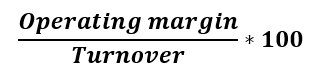
Operating margin
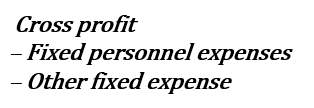
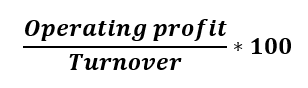
Operating profit %
The operating profit margin is obtained by relating gross profit to turnover. Operating profit is calculated by deducting depreciation according to plan from Operating margin. The operating profit margin indicates how much the company’s operating result represents in relation to revenue before financial items are deducted.
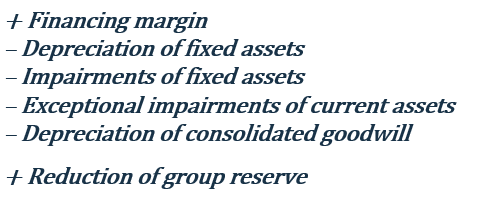
Financing margin
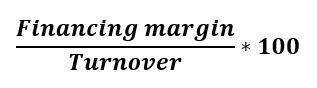
Financing margin and the financing margin % describe the company’s ability to cover loan repayments as well as the self-financed portion of working capital and investments using the profit generated from core operations and regular other business activities. The financing profit should be sufficient at least to cover repayments of existing loans. This indicator is of particular interest to lenders
Financing margin-%
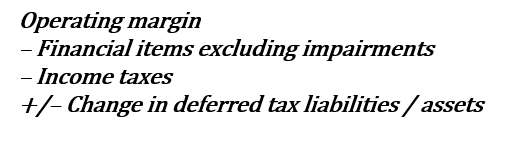
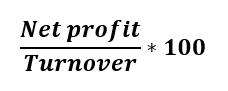
Netprofit
Net profit-%
Return on equity % describes the company’s ability to manage the capital invested in the company by its owners. The target level for this indicator is determined by the owners’ return requirements. The company must be able to generate returns not only on borrowed capital but also on its own equity
Return on equity %

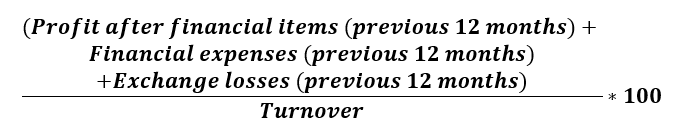
The return on capital employed also incorporates the input factor — the amount of capital resources committed. This indicator expresses the return generated by regular business operations in relation to the sum of interest-bearing liabilities and equity. As a minimum requirement for the value of this indicator, one may consider the average interest rate on borrowed capital, since interest-bearing debt must naturally generate at least a return equal to its interest cost
Return on capital employed %

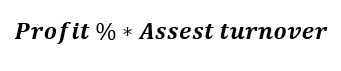
A company’s relative profitability can also be examined using the return on investment (ROI). This indicator can be divided into two components: capital turnover and profit margin. ROI is the result of these two factors. Thus, a company’s profitability can be improved by influencing either one of these individual components.
ROI %
Profit %
Asset turnover
